
Talapuṣpapuṭa (1st) ( Jāyasenāpati 1st)
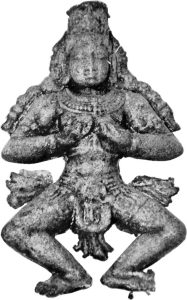
In the first Karaṇa itself the Chidambaram representaton, as given in GOS.I. (both end.), is defective or at least not sufficiently correct. Following Abhinavagupta, Jāya gives a very detailed descripton of this (IV.27-32). The ‘Tala’ in its name stands for Talasañcāra or Agratalasañcāra which is the pose of one of the legs here. In Talasañcāra-pāda, the heal should be raised (N.S.IX.273) and consequently the hip on this side will be a little tilled up. (व्याभुग्नकटि – Vyābhugnakaṭi) But in the Chidambaram sculpture, the feet are both evenly flat and even so the hip on either side. On the other hand, in the Tanjore sculptures the Talasañcāra-pāda and Vyābhugnakaṭi are beautifully shown; and it is the Tanjore illustration that is close to Bharata, Abhinavagupta and Jāya. The Tāṇḍavalakṣaṇa has selected a Chidambaram piece (fig. 15) which is closer to Talapuṣpapuṭa. In Kumbhakoṇam, the Talapuṣpapuṭa, which is alright, is No. 18 on the south side of the East face of the Gopura.
Varttita ( 2nd) (Jāya 27th)
The Chidambaram illustration as given in GOS.I. (both edns.) as well as the somewhat closer one given in the Tāṇḍavalakṣaṇa (fig.16), are both not quite correct in the representation of the hands which Abhinavagupta, and following him Jāya, say should be released on the thighs. While in the above- mentioned illustrations, the arms are loosely thrown somewhat apart from the legs, in the Tanjore illustration the arms are just, as required, on the thighs.
This illustrates also a case of somewhat different ways in which the expressions in Bharata – हस्तौनिपतितौ चोर्वोः । could be understood hastaunipatitau corvoḥ may mean let down so as to rest on thighs or so as to dangle by the sides of the thighs.
In many cases, a characteristic pose or movement of only one limb is specified and the other limb, hands or feet are either to continue from the previous (anuvṛtta), a well understood principle in Śāstra – writings, or done according to propriety, Aucitya, as Abhinavagupta elucidates on such occasions. Here in Varttita, – what is the exact pose of the feet? Bharata has not said anything of the pādas. One view received by Abhinavagupta is Agratalasañcāra continues from Talapuṣpapuṭa. Jāya explain this at length.
This Talasañcārapāda that is seen in Tanjore, but not in Chidambaram, where, however the pādas in Talapuṣpapuṭa continues.
Svastikarecita (7th) (Jāya 71st).
This is an interesting case for comparative study of the texts and the sculptures. The Chidambaram illustration agrees with Bharata, Abhinavagupta and Jāya. But the Tanjore illustration follows another tradition in which the legs are straight and close as in Samanakha, a version of this Karaṇa which Abhinavagupta cites anonymously and refutes. (समनखौ पादावनुवर्तत इत्यसत् – samanakhau pādāvanuvartata ityasat)
Nikuṭṭaka (9th) (Jāya 9th)
While Chidambaram and Tanjore agree on this, Kumbhakoṇam, which bears the number 9 and name Nikuṭṭaka clearly, presents the hands differently; without both hands being Nikuṭṭaka on shoulder, the left is at chest as in the next Karaṇa, with the right hand gracefully let loose as Ḍolā.
Ardhanikuṭṭita (10th) (Jāya 107th)
In the Chidambaram and Kumbhakoṇam sculptures, one of the hands has been brought to the chest but in the Tanjore illustration, both are at the head level as in Nikuṭṭaka. If the name Ardhanikuṭṭita should have some meaning and that meaning is that this is Nikuṭṭaka in some limbs (ardha), it will be hard to justify the Tanjore piece.
Pṛṣṭhasvastika (16th) (Jāya 26th).
The Chidambaram piece as reproduced in three publications, as also the one at Kumbhakoṇam where the name-label is clear, answers to the description of this in Bharata. But a multiplicity of interpretations of this Karaṇa and its name is seen in the Abhinavabhārati and Jāya. Jāya who devotes six verses to it speaks in detail of Kīrtidhara’s conception of it; here, after turning back, the dancer faces back the audience and one hand is to be on the chest. It is interesting to note that it is this Kīrtidhara-version that is found in the Tanjore Pṛṣṭhasvastika. The numbering of this Karaṇa in Kumbhakoṇam, which seems to be 22, is however puzzling.
A still further variety of this based on different interpretation of the name Pṛṣṭhasvastika, is recorded by Abhinavagupta, viz. with the crossed arms at the back. अन्ये तु पृष्ठविषये हस्ताभ्यां स्वस्तिक-मि-ध्वत्तो युद्धविषये परिक्रमऽस्य, प्रयोग (anye tu pṛṣṭhaviṣaye hastābhyāṃ svastika-mi-dhvatto yuddhaviṣaye parikrama’sya, prayoga) – but this is not represented in any of the Sculptures.
Ardhasvastika (22nd) (Jāya 24th)
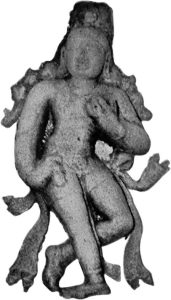
Bharata’s description of this (IV.83) requires the right hand to be stretched as Kari-hasta and left to be at the chest. But in the sculpture in Chidambaram the right hand is near the hip, i.e. in Kati-hasta. In his commentary, Abhinavagupta points out that in the place of Kari-hasta, some read Kati-hasta and Jāya on this Karaṇa (p.112) says more elaborately and specifically that Kati-hasta is given by Kīrtidhara, Bhaṭṭa Taṇḍu and their followers. In the Tanjore sculpture, the Kati-hasta is seen on the right hand. From this, it is clear that the sculptures of Chidambaram and Tanjore are both after the Kīrtidhara- Taṇḍu tradition.
Bhujaṅgatrāsita (24th) ( Jāya 69th).
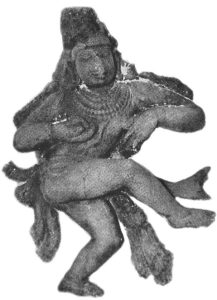
The description of this inBharata and the explanation in Abhinavagupta are clear. Jāya’s description is also clear. It is the Chidambaram illustration which is close to this description. In Tanjore, both right leg and the hands are in a different pose, the former being in the well-known pose of the Naṭarāja image. The Kumbhakoṇam representation (No.24, East face, right side) agree with that in Tanjore. Jāya does not record any variant form of this to thorw light on the Tanjore representation; but in two subsequent instances where Bhujaṅgatrāsita forms part of the Karaṇa, viz. Bhujaṅgatrastarecita and Bhujaṅgañcita, it is the common Naṭarāja form of leg that is given in Chidambaram too.
Ghūrṇita (32nd) (Jāya 131st)
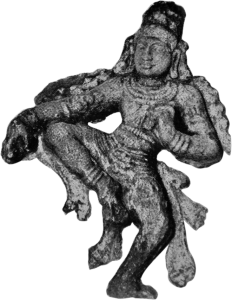
According to the vulgate version, the legs form a Svastika and then move aside, but according to Kīrtidhara as recorded by Jāya, the Svastika of the legs preceded by a jump is the important feature of this Karaṇa. It may be seen that the former version is followed by Chidambaram, the latter by Tanjore.
Nūpura (36th) (Jāya 100th)
The hands in this are said to be Recita-latas’ in the Kīrtidhara-version, according to Jāya; and it is interesting to note that it is this version that is followed both in Chidambaram and Tanjore.
Vaiśākharecita (37th) (Jāya 80 th)
Jāya records that according to Kīrtidhara, the Sthāna here, contrary to the Karaṇa-name, is Vaiṣṇava. Tanjore shows correct Vaiśākha; Chidambaram is prone to Vaiṣṇava; also only one hand is Recita in Tanjore, and in Chidambaram neither hand is Recita which again is against the very Karaṇa-name.
Latāvṛścika (44th) (Jāya 79th)
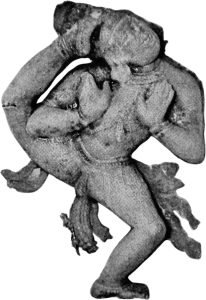
The depiction of this in Chidambaram and Tanjore are correct. But in Kumbhakoṇam (No.3 South face, western side) both the hands are at chest, without one of them (the left) being Latā, which is wrong. The very name of the Karaṇa means that the leg is in Vṛścika and hand in Latā.
Krānta (51st ) (Jāya 2nd)
Both Chidambaram and Tanjore follow the text but while the former seems somewhat literal, the latter seems to understand the dynamics of this Karaṇa better, by catching hold of the action of turning, Parikrama or Vyāvarttita which both Abhinavagupta and Jāya mention; this latter would also answer to the application of Uddhataparikrama, of the moving about of a haughty person.
Cakramaṇḍala (53rd) (Jāya 14th)
This again is shown in Chidambaram as a seated Karaṇa. But in Tanjore it iscorrectly shown not only as a standing Karaṇa but also as bringing out, by the twistgiven to the lower half of the body, the wheeling round required by the name (Cakravadbhramaṇa as Jāya says.)
Argaḷa (57th) (Jāya 23rd)
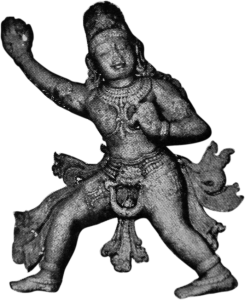
This is a difficult Karaṇa for identification. Its name is after its arms which are stretched across the body like bolts. So far as Chidambaram is concerned, the illustrations in GOS.I, first edn. and the one in the second edn. are both incorrect. What is Argaḷa for the first edition and Tāṇḍavalakṣaṇa is Prenkholita for the second and what is Argaḷa for the latter is Atikrānta for the former. Tanjore steers clear of this confusion and offers what appears to be correct Argaḷa. Kumbhakoṇam presents Tanjore Argaḷa but with the labal Preṅkholita.
Vikṣipta (58th) (Jāya 30th)
The illustration of this in GOS. I first edn. and the Tāṇḍavalakṣaṇa is wrong. This is a dynamic Karaṇa involving the swinging of both hands and feet forward and backward and neither the pose nor repose of the figure in these two books would answer to this Karaṇa. GOS. second edn. tries to improve with a more dynamic Karaṇa, but not the correct one. The Tanjore representation seems to be correct, though the leg is caught by the sculptor not during its Vikṣepa but when it touches the ground again.
However, Abhinavagupta’s interpretation of this that one leg should be Kuñcita at the back of another, at the heel, an interepretation followed first by Jāya, does not seem to be warranted. The word ‘Niśumbh’ which gives the Karaṇa-name, means ‘heavy treading’[1] and in addition to pointing this out, Abhinavagupta says that this might be used for showing Maheśvara. This ‘heavy treading’, as if stamping the ground, can be shown in the vulghat way or the Kīrtidhara way. As this Karaṇa relates to walking, Tanjore shows this dynamic aspect by taking the figure in profile and not in front-view; and in walking in this heavy manner, the legs and hands will alternately go up and down; when the hands go up, the Lalāṭa-tilaka by hand, which Bharata mentions, would occur and when they go down Kīrtidhara’s Adhomukha-Sūcīmukha would occur. As for Kuñcita and Vṛścika of the legs, the latter is but an accentuation of the former; but such vertical toss-up as in
[1] c.f. I s.IX.274 Tripada Agratalasañcāra and among its uses. Niṣumbhana; also Mālatīmādhava, V.22. in the description of Cāmuṇḍa.
Chidambaram would never occur in this Karaṇa. This detailed examination shows also how variant versions of the Karaṇas grew.